4 – Red Meat

Meatballs are a deceptively tricky dish. It looks like you’d just ball up some ground beef and be done with it, but in fact it takes a good bit of work to get meatballs that aren’t super-dense cannonballs. I experimented a little to find a good mix-in to keep the meatballs moist and light, and when it comes down to it, nothing beats bread. Luckily, Udi’s Gluten-Free White Sandwich Bread is both consistent with our diet and perfect for this dish.

Read Full Article

NOTE: An updated version of this recipe appears in my cookbook, The Ancestral Table.

Loco moco is a Hawaiian dish and popular breakfast meal on the islands. It’s the ultimate breakfast meal prior to a big workday, consisting of rice, a hamburger patty, fried eggs, and brown gravy. Its unique mix of ingredients create a distinct taste that I’ve been missing lately, so I decided to whip one up the other day.

Read Full Article

We prefer to eat our short ribs in the form of kalbi, but roasting an entire rack is also a rewarding experience. Off the rack, these ribs are meaty, fatty and delicious.

Although my pork ribs are usually cooked by braising or boiling and then grilling, I decided to do the opposite this time around, and grill them first. The result is soft, juicy meat – akin to a pot roast.

Read Full Article

NOTE: An updated version of this recipe appears in my cookbooks, The Ancestral Table and Paleo Takeout.

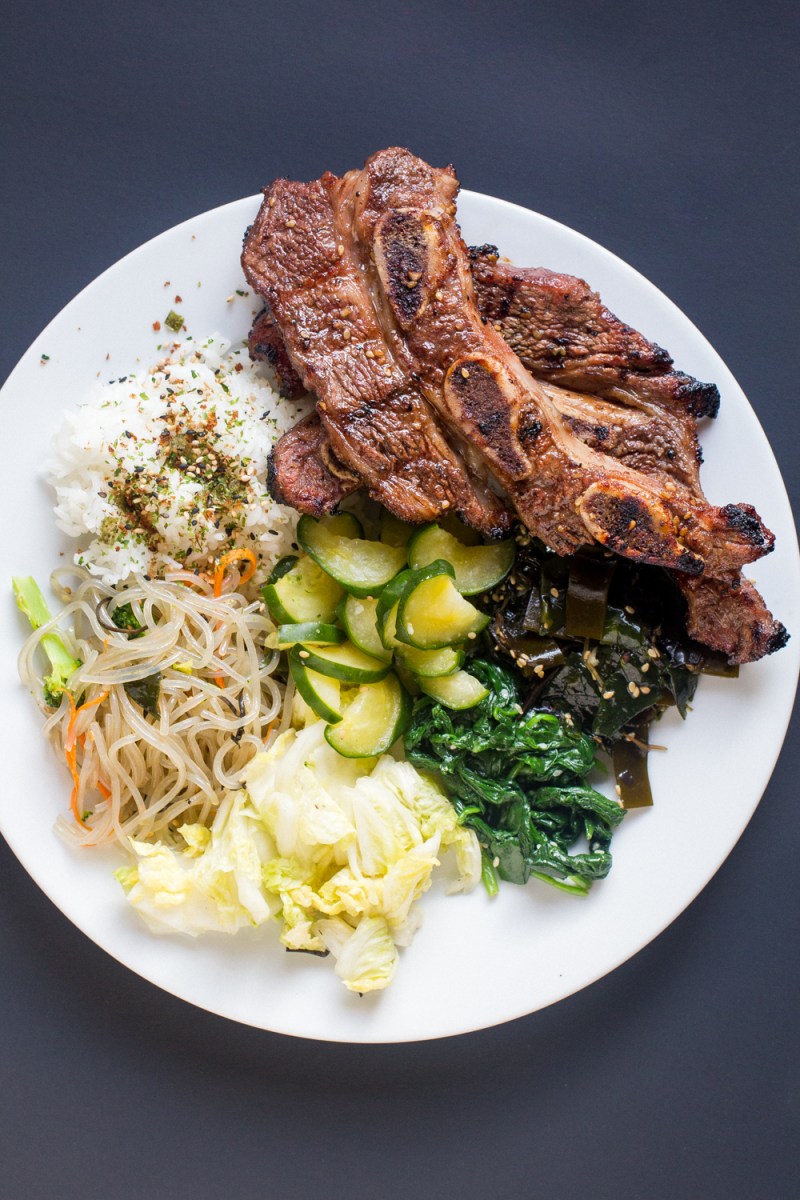
Kalbi (also known as Galbi) is one of my favorite meat dishes to grill at home. Unfortunately, all of the commercially-available marinades contain all sorts of nefarious ingredients, so I decided to try making the sauce from scratch. Luckily, it turned out to be really easy and tasted great.

This recipe calls for one Asian pear, but a regular golden pear, or even unsweetened applesauce, will do in a pinch.

Read Full Article

Hands down, the worst thing about switching to a strict Paleo diet is its systematic eradication of all good Mexican food. No tortillas (corn or flour), no beans, no rice, and no cheese? Sheesh. Even with our adjusted version of the diet (which includes dairy and rice), Mexican food still doesn’t seem as tantalizing. I’ve been experimenting a bit and have finally come up with a tortilla-free recipe that it worth sharing – despite the fact that it looks alarmingly like a casserole.

This recipe liberally uses queso fresco, which you should be able to find in any international food market. It’s a mild white cheese that’s used in most authentic Mexican dishes.

Read Full Article

Making a good pot roast is a infinitely rewarding experience; how else can you take a relatively cheap and tough piece of meat, leave it alone for a few hours, and have a rich and delicious meal waiting for you at the end? Sunday roasts are a tradition here in the Western world, and we don’t make this dish often enough. I have two simple rules when it comes to judging a successful pot roast: 1) it should never require a knife to cut, and 2) gravy should be minimal and complementary, and not used as a quick fix for a dry roast. Many cuts of beef can be used for pot roast, but I have found that a chuck roast has the perfect blend of affordability and marbling.

Let’s talk about how I approach this dish, and most other roasts. The term “to roast” actually means to cook in a dry heat, which can often result in a dry dish. Roasting in its most effective form is over an open flame or a rotisserie, which is definitely not what we’re going for with this dish. Most of the “roasting” I do is actually “braising” – roasting it in liquid – which is also commonly called “pot roasting” (you can see the ambiguity, right?). Braising a piece of meat is important because it allows the meat’s connective tissue to melt, resulting in a tastier and more tender dish. With a dry roast, you are likely to have a dry meat with hardened connective tissue.

I should also mention that this roast, and many of my other dishes, wouldn’t be possible without my incredible Le Creuset French Oven. What makes this oven ideal is its heavy cover which keeps moisture locked in. Its $275 price point might seem steep, but you can use it in hundreds of ways and has a 101-year warranty. If you’re going to have only one dish for the rest of your life, I say that you’d be safe with this one.

Read Full Article

I’m pretty sure that cheeseburgers are mankind’s greatest invention. I often imagine that if I had a time machine, the first thing I would do is travel to the Middle Ages with a perfectly-made burger and give it to a pauper and blow his mind. You think I’m joking, but I’m not. Cheeseburgers (with the bun) are probably the food I crave most, even after my palate shifted a few months ago. And truth be told, I still miss the fluffy/greasy bun associated with burgers, but I’ve come to appreciate bunless burgers as well.

I worked at a burger-centric restaurant for a couple years, and learned a couple tricks along the way. Here’s how I make a perfect cheeseburger.

Read Full Article

NOTE: An updated version of this recipe appears in my cookbook, The Ancestral Table.

Many stores or butcher shops have beef marrow bones on the cheap, which make a dense and highly nutritious stock and excellent soup base. Although I’ve made my own stock using oxtails I’ve been wanting to try my hand at other soups, so marrow bones seemed like the best starting spot.

Before we dive into this recipe, let’s have a quick culinary lesson. “Stock” refers to a liquid that’s made from simmering bones, and “broth” is made from meat. You can use both, and as far as I know that’s still referred to as “stock”. Now that we have that cleared up, let’s make some food.

Read Full Article

NOTE: An updated version of this recipe appears in my cookbook, The Ancestral Table.

Animal fat gets a bad rap this days, mostly because we’re scared of those totally-dangerous saturated fats. The old fast food joints used to cook their fries in lard (rendered pork far) or tallow (rendered beef fat, also known as suet) until the low-fat craze of the 70s forced everyone to use vegetable shortening (and their lovely, cancer-causing trans fats). I’ve looked around for animal fats to use in cooking but all I’ve found is partially-hydrogenated lard, and I’ve come to learn that the hydrogenation process, while useful because it allows for the lard to be kept at room temperature, also has trans fats. While we’re still searching for pork fat to render lard, our local Whole Foods has been more than happy to set beef fat aside for us as they trim their cuts down for sale. Within a day they had 10 lbs of beef fat for us, which I rendered into tallow the other day.

There are two ways to render fat – “wet” or “dry”. Dry rendering is simply leaving fat pieces to cook on low in a stockpot or crockpot until the fat has liquified (leaving cracklings for later), but the fat can burn and leave a bad taste in the tallow. I decided to do a wet render (which basically involves boiling the fat pieces until the liquid fat has been extracted). I found the whole experience to be surprisingly easy.

Read Full Article

NOTE: An updated version of this recipe appears in my cookbook, The Ancestral Table.

Editor’s Note: this recipe is from before I switched to the Paleo Diet, but all you need to do to make this dish Paleo-friendly is omit the beans.

Ah, chili. One of the most hotly-debated dishes a person can serve in America, perhaps second only to BBQ ribs. And like many of my other recipes, I’m quick to concede that this recipe isn’t for everyone; this is a generally mild chili that goes well with chili dogs, chili burgers, or on top of a scoop of white rice.

For me, the most important aspect of chili is having it blend into one single element and texture – nothing bothers me more than a chili that just looks like a bunch of ingredients thrown together. Luckily, my handy Magic Bullet helps to puree most of the chunkier ingredients while still retaining its necessary taste. I also add a couple of seemingly odd ingredients, which play important roles: cocoa powder for richness and complexity, and mayonnaise for smoothness and just a touch of creaminess.

This dish takes a little over three hours to make: one hour to prep and soften the tomatoes and two hours to cook the chili itself.

Read Full Article