
4 – Red Meat

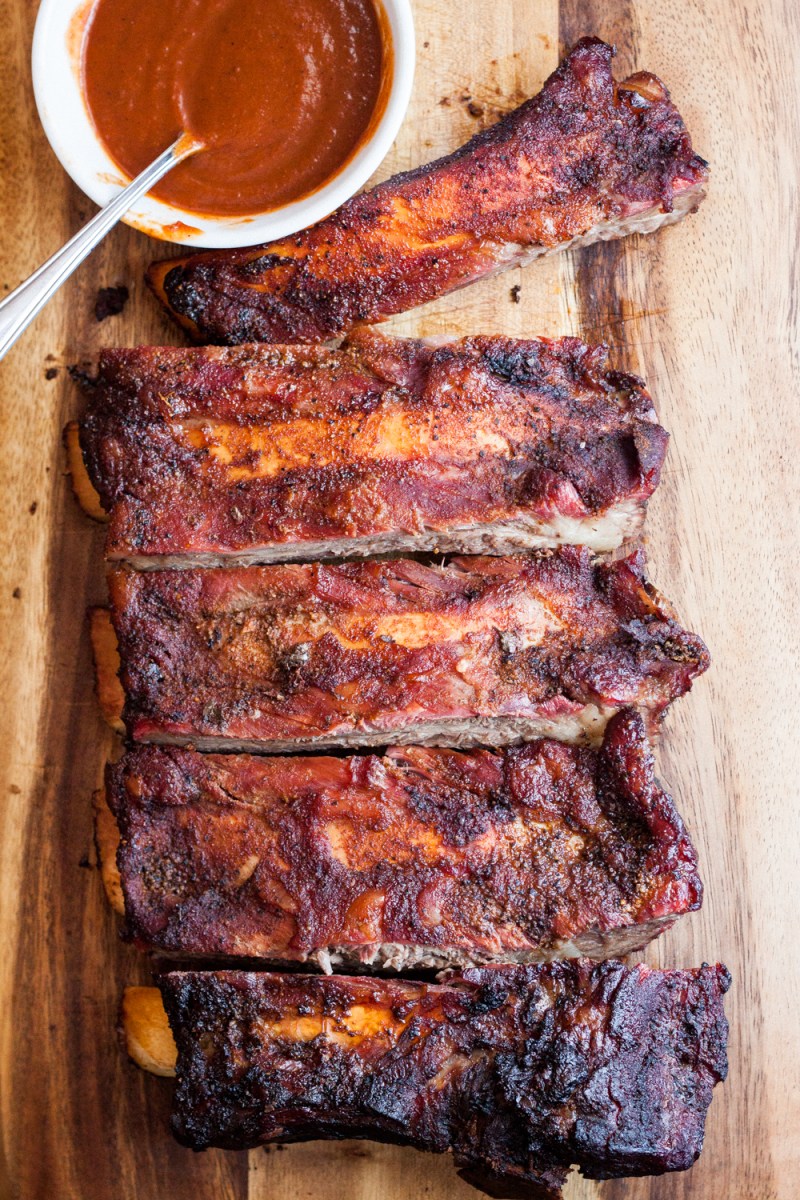
US Wellness Meats recently asked me to make a recipe for their beef back ribs, and I was happy to oblige (note: don’t ever turn down ribs). Little did I know, I was in for a surprise: this package, which included four racks of ribs, weighed in at SIXTEEN POUNDS of beefy goodness. I immediately knew that I had to call in for backup to give these monsters the attention they deserved.

Enter my friend Jeremy from SeaDog BBQ. SeaDog BBQ is a locally-based Kansas City Barbeque Society competition team, and they’ve done pretty well here in Maryland against some very talented teams. Not only did he come up with an awesome sugar-free barbecue rub recipe to accompany these beef ribs, he brought over his own smoker! While his smoker is from a small, locally-produced source, he did mention that the Weber Smokey Mountain is one of the best introductory smokers that are commercially available. If you don’t own a smoker, never fear – I added tips on how to replicate this recipe using a grill.

Okay, enough with the background, on to the ribs! For this recipe we cooked two of the racks, totaling eight pounds. We opted for a dry, sauceless cooking method, typical of Memphis-style barbecue, with an hour’s braise in the middle to speed up the cooking process and to keep the ribs juicy and full of beefy flavor.

Read Full Article

Gyro meat, often referred to as doner or shawarma meat, is simply meat roasted on a rotating vertical spit and shaved off. Most Mediterranean and Middle-Eastern countries have some variation of this dish as a common street food. Depending on where you’re getting it, the meat can be made of lamb, beef, goat, chicken or a combination of meats. It’s one of my favorite meats of all time, and one that’s not easily replicated at home without a rotisserie setup. Lava Lake Lamb was gracious enough to send me some ground lamb recently, so I thought it was time to try and figure out how to make it on my own.

I spent a lot of time researching how to make authentic gyro meat at home, and in the end I found that Alton Brown’s approach was just about perfect. It involves processing the meat to make a thick paste, which is then stored for a couple hours before being cooked on the grill using a rotisserie or in the oven using a meatloaf pan. I went with the meatloaf pan variation with just a few adjustments, and it was awesome.

Read Full Article

NOTE: An updated version of this recipe appears in my cookbook, The Ancestral Table.

US Wellness Meats recently sent me a package of their grass-fed bison stew meat, and I jumped on the opportunity to make a traditional hearty stew. Rather than settle on the all-too-common crockpot stew (nothing against those), I opted to make this stew the traditional way – browned meat, sautéed onions, simmering wine-and-stock broth, and incrementally-added ingredients – to make sure the final product was both decadent and perfectly-crafted. That might sound like a lot of work, but it really isn’t – this is a dish that can easily be completed in a few hours.

Although the American bison is often referred to as a buffalo, it is only a distant relative of the true buffalo (like the Asian water buffalo). Its closest relative is the European bison, also known as a wisent. Its meat is usually leaner than beef, high in iron, and sweeter-tasting. Because of its leanness, I find that it’s best served in slow-cooked meals like this stew, as hamburgers, or as a grilled meat (like shish-kabobs) served medium-rare.

If you don’t have bison meat on hand, never fear – this stew tastes just as great with beef or lamb stew meat!

Read Full Article

Lamb is a delicate but rewarding meat; while a lot can go wrong when cooking it, when you get it right it’s an unforgettable experience. US Wellness Meats recently sent me one of their rack of lamb split loin roasts, and honestly, it was a little intimidating. Not only is this one of the most tender parts of the lamb, it needed some initial carving/butchering as well. Since one of my goals of this site is to make cooking less intimidating, I was happy to have the opportunity to demystify this formidable cut of beast.

I went with a French-inspired preparation of the dish. I carved the rack into a rolled loin roast, and used the leftover bone pieces to make an on-the-spot broth while the roast marinated. This broth then served as a base for my mint/parsley/mustard sauce.

Read Full Article

NOTE: An updated version of this recipe appears in my cookbook, The Ancestral Table.

Growing up with the Standard American Diet (otherwise known as SAD), I became accustomed to certain tastes. One of my favorite random meals was Salisbury steak TV dinners – something about that squishy meat and savory broth really hit the spot for me. So I decided to re-create this dish, but instead of squishy, breadcrumb-filled beef, I used some of the best ground beef I’ve ever tasted – US Wellness Meats’ 75% lean ground beef (by the way, their 25lb. bulk pack is on sale until 10PM CST on Saturday, March 3rd!). It tasted just as good as it looks.

Interestingly enough, Salisbury steak was first developed in the late 19th century by Dr. J H Salisbury as a low-carb, weight-loss dish. Similar dishes are popular worldwide, especially in Japan (hanbāgu steak) and Russian (котлета).

Read Full Article

NOTE: An updated version of this recipe appears in my cookbook, The Ancestral Table.

Although flanken-cut short ribs (sometimes called L.A. or English cut ribs) are more commonly found in Korean restaurants today, every so often you’ll find that a chef that prepares kalbi (galbi, 갈비) in the traditional way – by using a full length of rib that’s filleted in layers. This traditional cut is called wang galbi/kalbi, which is literally translated as “king ribs”.

My most recent box of goodies from US Wellness Meats included a package of their delicious beef short ribs. This beautiful one-pound rack was the perfect opportunity to make some “king ribs” of my own.

Read Full Article

Yesterday I posted my own recipe for one of Alex Boake’s awesome illustrations. I was really happy with the results.

Additionally, I’ve got a little secret: in writing up one of her creations, I secretly coerced her into making an illustration of one of my recipes. She decided to take on my kalbi recipe, and her piece is probably the coolest thing on the entire internet right now. Head over to her blog to check out her post about my recipe.

Liver and onions. You really can’t say the former without saying the latter, at least here in the United States. Surprisingly, I had a hard time finding anyone that’d even try and tackle beef liver in many of my cookbooks. Instead, I had to scour the internet for something palatable. Your typical online liver and onions recipe calls for sautéing the liver for a few minutes on each side, and then throwing some onions on top to simmer until they’re cooked through. While that does effectively mix the onion flavor with the liver, it also can easily result in a gray, overcooked and dry liver.

US Wellness Meats recently sent me a package of their beef liver to make a recipe for their site; the liver comes from grass-fed, antibiotic-free, non-added hormone cows. As far as organs go, it was beautiful! I thought this was the perfect time to try a liver recipe I’ve been cooking up in my head for a while now. The process uses a combination of sautéed liver, caramelized onions, and crispy bacon to create a textured and slightly complicated taste from a dead simple ingredients list. I think it turned out pretty well.

Read Full Article

NOTE: An updated version of this recipe appears in my cookbook, The Ancestral Table.

Eye of round is a pretty intimidating piece of beef. It’s an extremely lean cut taken from the hindquarters of the cow, which gets a lot of exercise. To be honest, I usually just use the eye of round roast to make jerky (along with london broil, which is also from the same area of the cow) because making steaks and roasts with this part of the cow is usually always a gamble.

The other day I stumbled upon a recipe that seemed both crazy and intriguing; you roast the meat at a high temperature for a while, and then you turn off the oven and leave it in there for 2 1/2 hours. The end result is something like prime rib – a dark, crusty outside with a juicy, pink, tender inside. Honestly, it makes this fairly inexpensive cut of meat taste about 100x better than what you paid for. I may never cook an eye of round roast any other way for the rest of my life!

Read Full Article

Note: an updated version of this recipe is here.

Beef stroganoff (бефстроганов) is a Russian dish that dates back to the 19th century. The dish became popular here in the US after World War II, when Russian immigrants and American soldiers returning from war brought it stateside.

Historically, the dish was served in a sauce made primarily of mustard and sour cream. Other variations include a little tomato paste for zing. Here in the US, it’s generally served with onion and mushrooms as well; it turns out that a little of everything is what tastes the best.

Read Full Article