Page 52 of 55

My wife bought the fermentation jar you see above for my birthday today, and I am pretty stoked. I’ve been wanting to make my own pickles, sauerkraut and kimchee for a while now so this is perfect. It’s under $10 and available here. I’m looking forward to finding the most natural and healthy pickling methods around, so if you have any suggestions please send them my way.

She also got me Julia Child’s Mastering the Art of French Cooking Vol 1. I think it’ll give me insight into some hearty, full-fat French culinary methods that I can use as a baseline in the future. I’ve found that my cooking instincts have eerily fallen in line with French culinary style, so this may really push me to refining my taste.

NOTE: An updated version of this recipe appears in my cookbook, The Ancestral Table.

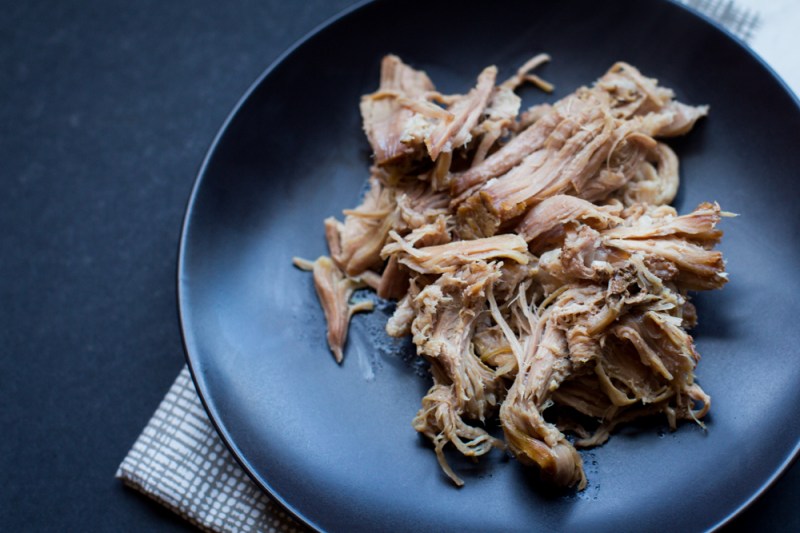
Kalua pig is one of Hawaii’s best-known dishes, and easily replicated at home. Traditionally, an entire pig is placed in an underground pit (“imu” in Hawaiian) that is lined with hot rocks and wrapped in banana leaves, then covered with a layer of soil and roasted overnight. Since we don’t have room in our back yard for an imu, nor access to a suckling pig and banana leaves, nor the desire to go through such a hassle, we just use a crock pot or french oven.

This recipe calls for about 6 lbs of pork butt, which is actually the upper half of a pig’s shoulder (the lower half is called the picnic cut, which can also be used). Pork butt is also often called a Boston butt or roast. You can also find the cut simply labeled as “pork shoulder”. Basically, any cut that’s labeled picnic, butt, shoulder or Boston should be fine.

Read Full Article

As I was putting together a quick lunch the other day I made this simple soup, and didn’t take any pictures of the process because I assumed it wasn’t going to be a very noteworthy meal. Fortunately for me it was delicious, but unfortunately for you I don’t have any other pictures of the recipe other than the picture you see above. Regardless, I think I can still walk you through this dish without any visual help.

I lived in Hawaii for seven years, and I was lucky to learn a lot about Asian soups while I was there, and I feel that this dish accurately reflects the all-inclusive nature of Hawaiian (“local”) cuisine. This soup is a combination of many traditional dishes: I made a broth similar to Japanese shoyu ramen, but incorporated assorted Japanese fishcake from a dish called oden, and used wakame seaweed which is most commonly found in miso soup. I then used the same rice noodles used in Vietnamese pho and added fish balls, which you would find in many soups in Singapore and Malaysia.

Read Full Article

I’m pretty sure that cheeseburgers are mankind’s greatest invention. I often imagine that if I had a time machine, the first thing I would do is travel to the Middle Ages with a perfectly-made burger and give it to a pauper and blow his mind. You think I’m joking, but I’m not. Cheeseburgers (with the bun) are probably the food I crave most, even after my palate shifted a few months ago. And truth be told, I still miss the fluffy/greasy bun associated with burgers, but I’ve come to appreciate bunless burgers as well.

I worked at a burger-centric restaurant for a couple years, and learned a couple tricks along the way. Here’s how I make a perfect cheeseburger.

Read Full Article


image courtesy of Minnesota Agricultural Experiment Society

I usually find most conventional nutritional advice to be somewhat amusing, considering that a lot of it is driven by financial interest and not health. I’m not an expert by any stretch, but even with my limited knowledge I can see through most nutritional campaigns. What’s upsetting is that some of it can be potentially dangerous since most people don’t spend much time researching nutrition on their own and rely on easy-to-read columns and the like. I stumbled upon this article on Parents magazine entitled 10 Things You Need to Know About the New USDA Guidelines and found it so repulsive that I had to comment each of its assumptions.

Read Full Article

NOTE: An updated version of this recipe appears in my cookbook, The Ancestral Table.

Many stores or butcher shops have beef marrow bones on the cheap, which make a dense and highly nutritious stock and excellent soup base. Although I’ve made my own stock using oxtails I’ve been wanting to try my hand at other soups, so marrow bones seemed like the best starting spot.

Before we dive into this recipe, let’s have a quick culinary lesson. “Stock” refers to a liquid that’s made from simmering bones, and “broth” is made from meat. You can use both, and as far as I know that’s still referred to as “stock”. Now that we have that cleared up, let’s make some food.

Read Full Article

One of the most common curries you’ll find in Indian restaurants here in the US is chicken tikka masala, a creamy, tomato-based sauce with slow-roasted chicken chunks. Being that it’s so popular, it’s easy to find pre-made sauces in most grocery stores; after putting several through their paces, I’ve settled on a quick, foolproof chicken tikka masala for an easy weeknight dinner.

One of the more interesting facts about this dish is that its place of origin is under dispute; there’s a good chance that it was invented in either India or England.

Read Full Article

Those pancakes look great, right? Totally delicious, huh? Not really. Truth is, I know how to make a fine looking pancake (let’s chock that up to my brief stint at IHOP as a teenager), but these pancakes didn’t taste very good at all. I think it just goes to show that gluten-free substitutions don’t always pan out.

Despite my gross pancake experience, I thought that now would be a good time to give some pancake tips. You first want to concentrate on the batter, and my biggest suggestion is to not over-stir the mix. You want to make sure the batter is still a little bubbly, and let it sit for at least five minutes. Once you pour the batter onto a medium-heated and slightly greased pan, you want to flip it at the perfect moment: when the batter is bubbling and the edges are slightly dried. Once flipped, you only want to cook the other side for about 45 seconds.

Okay, let’s get down to business.

Read Full Article

If you think that gluten-free breads taste good, I would say that you haven’t tasted gluten-free bread. Seriously, for a guy that’s not a huge fan of bread in the first place, gluten-free varieties are never fun: they’re either dense beyond belief or have a strange consistency. For that very reason, I’ve been leery of all gluten-free substitutes. However, pizza deprivation can drive a man to do some crazy things, and lately I’ve tried my hand at gluten-free pizza.

I realize that there are Paleo pizza crusts out there that are made with ground nuts, but I don’t have the courage to try one of those yet. Maybe later. I’m also sure that there are plenty of homemade crust recipes on the internet but I figure for now I’ll leave it up to the experts.

First, a word on how to cook a proper pizza at home. I’m not a big fan of tomato chunks in my red sauce, so I will buy pre-made pizza sauce or I will blend a spaghetti sauce if I’m in a pinch. Sauce from scratch is always an option, but I like to consider pizza a quick meal so I don’t like to put too much work into it. Jarred sauce will generally taste better if you simmer it for 30 minutes to reduce acidity before applying it to the crust. We also like to use a pesto sauce; we brush melted butter on the crust and then spoon pesto sauce on.

Cheese placement is essential! You want to evenly spread grated cheese (picture above) or lay out slices of mozzarella (picture after the break). When the pizza is fully cooked, you will want to broil the top to bubble and brown the cheese. Let it rest for five minutes before slicing.

Read Full Article