
meat

NOTE: An updated version of this recipe appears in my cookbook, The Ancestral Table.

US Wellness Meats recently sent me a package of their grass-fed bison stew meat, and I jumped on the opportunity to make a traditional hearty stew. Rather than settle on the all-too-common crockpot stew (nothing against those), I opted to make this stew the traditional way – browned meat, sautéed onions, simmering wine-and-stock broth, and incrementally-added ingredients – to make sure the final product was both decadent and perfectly-crafted. That might sound like a lot of work, but it really isn’t – this is a dish that can easily be completed in a few hours.

Although the American bison is often referred to as a buffalo, it is only a distant relative of the true buffalo (like the Asian water buffalo). Its closest relative is the European bison, also known as a wisent. Its meat is usually leaner than beef, high in iron, and sweeter-tasting. Because of its leanness, I find that it’s best served in slow-cooked meals like this stew, as hamburgers, or as a grilled meat (like shish-kabobs) served medium-rare.

If you don’t have bison meat on hand, never fear – this stew tastes just as great with beef or lamb stew meat!

Read Full Article

Edit: the giveaway is now closed! Congratulations to Maia Low who is the big winner!

You may have seen my recent recipes featuring some delicious meats from US Wellness Meats (including my liver and caramelized onions and honey and citrus glazed ham recipes). You may also have been salivating from the awesome looking meat and dreamed of making some of your own. Luckily for you, I am teaming up with US Wellness Meats to make your dreams a reality: we’re giving away a $100 gift certificate to their site!

And while a free $100 worth of meat sounds great, I have an even better proposal. How about you treat this $100 as a “grass-fed buffer” – in other words, calculate what you pay for the mediocre (and possibly toxic) meat that you can find at your local supermarket, and then use the $100 certificate to offset the cost of buying this delicious, healthy grass-fed beef. For example, let’s say you regularly pay $4/lb for ground beef at your supermarket. US Wellness Meats’ awesome 75/25 ground beef currently costs $6.45/lb. This means that if you win the giveaway, you could buy THIRTY EIGHT POUNDS of grass-fed ground beef for the same price as the same amount of conventional ground beef, and have money to spare even after paying their reasonable $7.50 handling fee (shipping on their site is free)! Just an idea – you can spend the $100 how you’d like, but that’s what I would do!

Here’s how to enter the giveaway (first one is required, second is optional):

1. Subscribe to the US Wellness Meats newsletter and leave a comment on this post letting me know you did it.
2. “Like” The Domestic Man facebook page and leave a comment on this post letting me know you did it.

If you do both options, I’ll give you two entries into the giveaway! You can tell me that you did both options in one comment instead of two. The giveaway ends midnight Saturday, February 11th, and I will select a winner using a random number generator sometime thereafter. Good luck!

Fine print: Giveaway for US residents only – US Wellness Meats is not able to ship internationally because of customs issues.

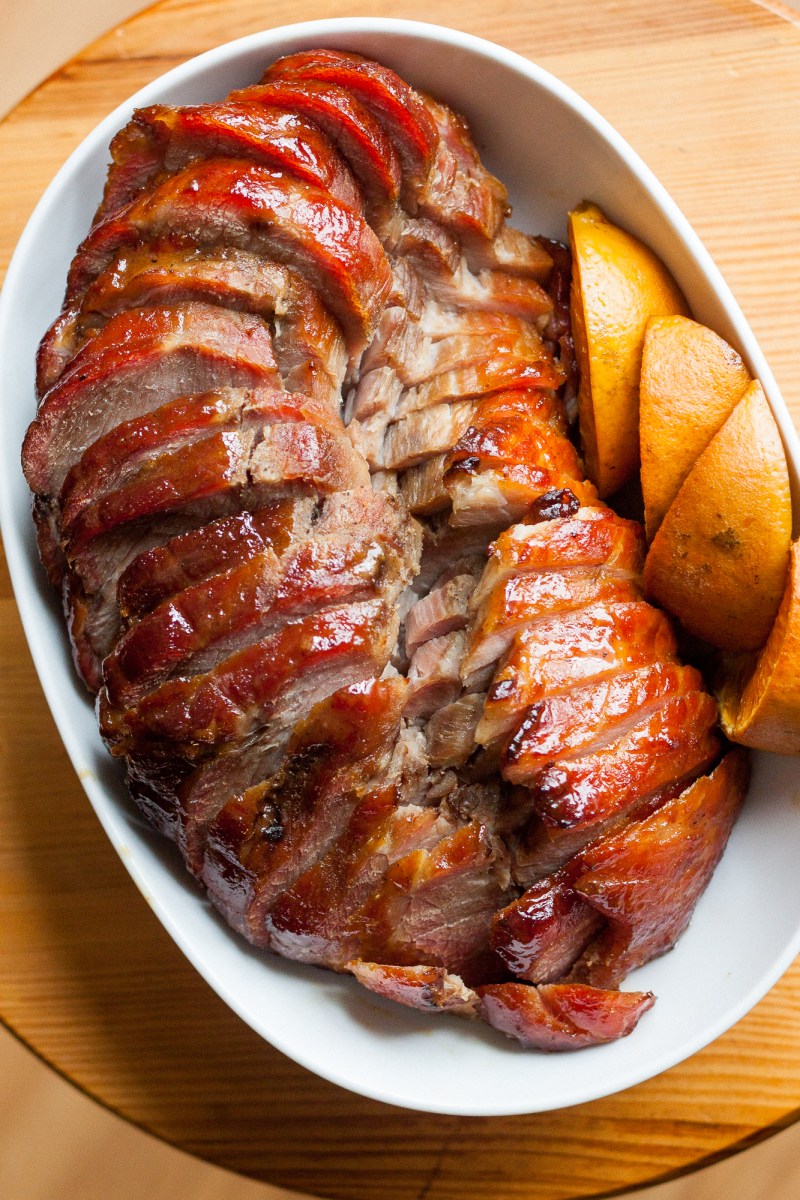
Ham seems like a simple hunk of meat. All you have to do is buy a cured, pre-sliced ham and warm it up in the oven. Unfortunately, while this is the easiest (and most common) way to get some ham in your belly, it’s not the healthiest option. Your everyday pre-cooked ham is loaded with sugar and nitrates.

I’ve been meaning to tackle an uncured ham for a while, so imagine my delight when US Wellness Meats asked me to write up a recipe for their petite ham. This smoked ham is both sugar and nitrate free, using compassionate certified pork. Its size is also perfect for our family of three – 2.5 lbs of porcine goodness. There was plenty for us to eat, and a good amount of leftovers to boot. For those of you using a cured and/or a spiral-cut ham, don’t worry – this recipe works just fine for them as well.

Read Full Article

Note: I’ve tweaked this recipe over the years, and HERE is my definitive method/recipe.

For Thanksgiving this year I tried my hand at roasting a turkey on the grill. The resulting bird was crispy on the outside and juicy and tender on the inside, and only took a few minutes longer than roasting it in the oven. Also, adding woods chips imparts an authentic smokey flavor that really made the turkey stand out on the Thanksgiving table. Lastly, it frees up the oven for other endeavors!

Also, when grilling a turkey (or roasting it in the oven, for that matter), you want to use a v-rack (often called a roasting rack). We just started using one recently and it’s amazing how evenly it cooks the bird, since it allows air to circulate around the entire turkey. Depending on how your grill plates run, though, the v-rack may fall through the plates; to prevent this, put the v-rack on a grill pan.

Read Full Article

For me (and probably many others), smothered pork chops remind me of being a kid. It is a generally easy way to make sure pork chops are both cooked thoroughly and not too tough or chewy, and many houses across America have their own variation. Unfortunately, too many of those recipes rely heavily on instant soup packets and/or cans, which are loaded with sodium, unhealthy oils, and wheat. In response, I set out to make a healthy alternative without compromising on taste. Here’s how it turned out.

Read Full Article

While in Germany last year, I came across a Bavarian dish called “Schweinshaxe” (pork knuckle), which is a ham hock that is boiled and roasted to a crisp. I enjoyed picking apart this barbarian hunk of meat, and I wanted to replicate the experience at home. Since uncured ham hocks are hard to come by, and most butchers would look at you funny if you asked for a pork knuckle, I decided to try out a different cut but with similar result.

I settled on a pork shoulder (same thing as a pork butt), which is easy to find and fairly marbled. Pork shoulder is the cut used in pulled pork, so I thought I would roast a shoulder in the grill but take it off before it starts to fall apart; the outer shell came out deliciously crispy and the meat was juicy and tender.

Read Full Article

Although breakfast is my least favorite meal to eat, I definitely like to prepare it. For a couple years I worked at a restaurant that served breakfast, and learned a couple cool dishes. The one you see above we called a “hobo” , which may not be the most politically correct term out there for it. Luckily, the chances of offending a homeless person is pretty low, since I assume that most homeless people a) don’t have access to the internet and b) don’t visit this site when they do get online.

A hobo is probably called that because it’s made by throwing a bunch of ingredients into a single pan. As far as I know, it always contains eggs, cheese, and potatoes, and some sort of meat. I like making this dish because it’s an easy way to get rid of leftover meat, as well as ingesting a good amount of healthy coconut oil.

Read Full Article

Making a good pot roast is a infinitely rewarding experience; how else can you take a relatively cheap and tough piece of meat, leave it alone for a few hours, and have a rich and delicious meal waiting for you at the end? Sunday roasts are a tradition here in the Western world, and we don’t make this dish often enough. I have two simple rules when it comes to judging a successful pot roast: 1) it should never require a knife to cut, and 2) gravy should be minimal and complementary, and not used as a quick fix for a dry roast. Many cuts of beef can be used for pot roast, but I have found that a chuck roast has the perfect blend of affordability and marbling.

Let’s talk about how I approach this dish, and most other roasts. The term “to roast” actually means to cook in a dry heat, which can often result in a dry dish. Roasting in its most effective form is over an open flame or a rotisserie, which is definitely not what we’re going for with this dish. Most of the “roasting” I do is actually “braising” – roasting it in liquid – which is also commonly called “pot roasting” (you can see the ambiguity, right?). Braising a piece of meat is important because it allows the meat’s connective tissue to melt, resulting in a tastier and more tender dish. With a dry roast, you are likely to have a dry meat with hardened connective tissue.

I should also mention that this roast, and many of my other dishes, wouldn’t be possible without my incredible Le Creuset French Oven. What makes this oven ideal is its heavy cover which keeps moisture locked in. Its $275 price point might seem steep, but you can use it in hundreds of ways and has a 101-year warranty. If you’re going to have only one dish for the rest of your life, I say that you’d be safe with this one.

Read Full Article