Potatoes

You’ve heard of Samosas, right? They’re those triangle-shaped savory pastries served in Indian and Central Asian restaurants. They’re a surprisingly ancient dish, first mentioned in the Middle East (under the name Sambosa) during the 10th century before eventually making their way across Central Asia, the Indian subcontinent, and even Southeast Asia. They’re practically everywhere today – you can even find them pretty easily in South Africa, as Indian cuisine started to influence British colonial food culture.

I loved Samosas in my pre-Paleo days, and I’ve been wanting to tackle them for a while. The problem is, well, pastry. I tend not to fiddle with baked goods and leave them up to the masters (see: Jenni Hulet and her book, My Paleo Patisserie). So after a bit of brainstorming, I settled on the idea of Samosa-flavored mashed potatoes. I like this idea because, heck, most people are probably eating mashed potatoes anyway, so why not kick them up a notch in terms of flavor and vegetable count.

Read Full Article

So, did you see the news? The Whole30 program now includes white potatoes. For those of you that aren’t familiar with Whole30, it is a 30-day eating program with a moderately strict interpretation of the Paleo template – no alcohol, sweeteners of any kind, or faux foods (like almond flour pancakes); in my cookbook, I reference it as “a tough-love plan to transform your diet.” It’s especially popular right around the New Year, as people look to clean up their eating habits.

Since its inception, the Whole30 has forbidden white potatoes, likely due to the fact that most potatoes are eaten in the form of chips or french fries. I have been an advocate for white potatoes since first changing my diet in 2010, after reading about the Perfect Health Diet. My inclusion of those little delicious tubers on this site has constantly confused readers who were introduced to Paleo through the Whole30 concept. So I’m happy to see that potatoes are gaining more acceptance as a whole food that has just as many nutrients as its favored cousin, the sweet potato.

White potatoes serve as an excellent example of mindful eating. They have a moderately high glycemic load, but studies have shown that it is greatly reduced when eaten with certain foods, especially fats and acids. So be sure to smother your baked potato with butter and sour cream. Also, the skin of white potatoes are high in glycoalkaloids, which can cause gastrointestinal irritation. This is a known issue – in fact, modern potatoes are much lower in glycoalkaloids than in earlier history, as farmers cultivated certain potatoes (especially the russet potato) to be more digestible.

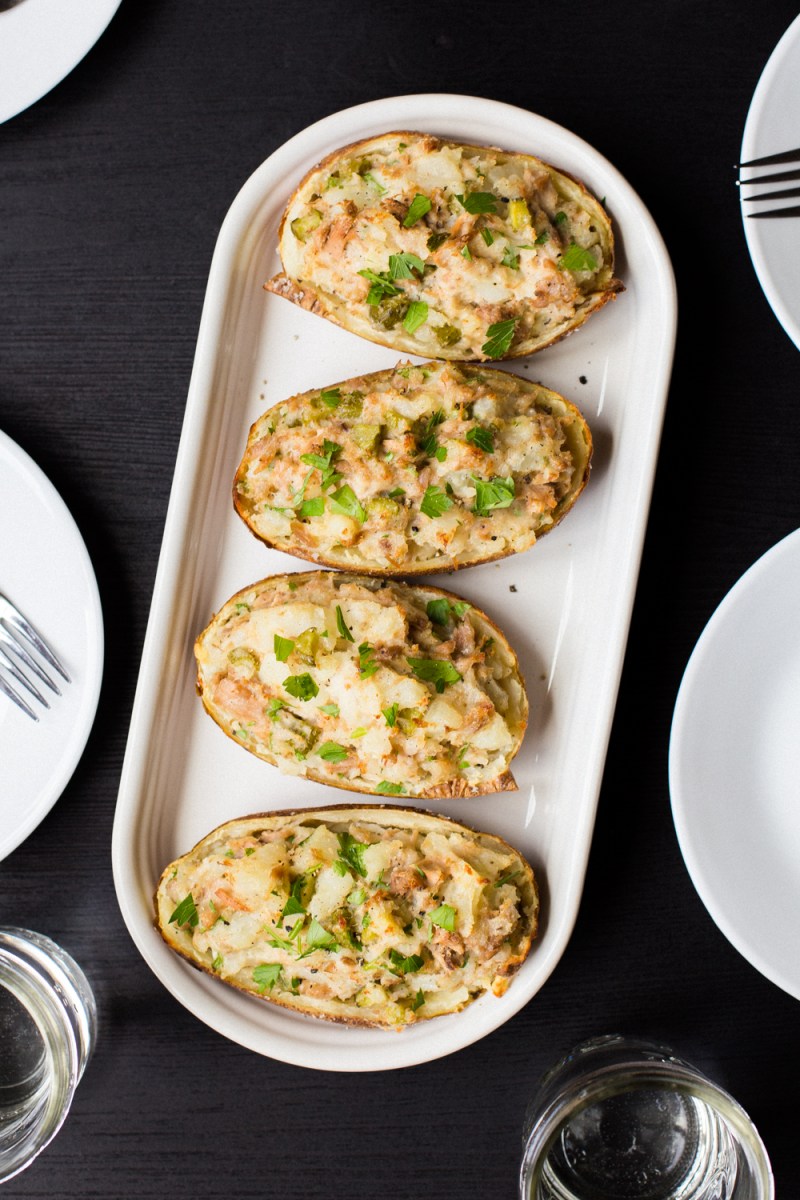
Preparation of potatoes is also important; when compared to white bread, boiled potatoes are 323% more satisfying per calorie. Potato chips? Only 91% as satisfying. That’s why most people are able to easily eat three potatoes’ worth of potato chips, when they’d have a hard time eating three boiled potatoes in one sitting. So at our house, we typically only eat our potatoes boiled (and mashed) or baked. Or twice baked, like in today’s recipe.

Read Full Article

Bacalhau à Brás is a Portuguese dish using salted cod (bacalhau), eggs, and potatoes. The Portuguese were one of the first European cultures to fish for cod, making huge harvests and preserving the fish off the coast of Newfoundland shortly after Columbus discovered the New World. Since then, this salted cod has been an integral part of Portuguese culture, and it’s often said that you can cook a new recipe using bacalhau every day of the year (some say there are over 1,000 recipes that include this fish). Advances in fishing technology in the mid 20th century had collapsed the Northwest Atlantic cod market by the 1990s – cod takes a long time to mature, and overfishing had run rampant. Today, bacalhau is most often made using cod harvested from Arctic waters under more strict quotas.

Bacalhau is made by salting and drying the fish in the sun; while it was originally a method of preservation (salted cod keeps a long time even without refrigeration), its unique, strong flavor is unmistakable and delicious, and its popularity endures today. The only downside to eating bacalhau is that it requires a bit of foresight, since it needs to be soaked overnight to reconstitute the fish.

Bacalhau à Brás is one of the most famous Portuguese dishes, and is considered the ultimate comfort meal in Portugal. The dish uses many of the quintessential ingredients found in Portuguese cooking – bacalhau, eggs, potatoes, and black olives.

Read Full Article

Boniato (also called batata or tropical sweet potato) is a white, starchy, and dry version of the common sweet potato. It’s popular in Florida and the Caribbean, but well-known throughout the Americas and some of Europe (Spain in particular). It was cultivated as far back as 1,000 years ago in Central and South America. Its skin is red-to-purple in color, and has white flesh. As far as I can tell, it is nearly identical to the Japanese sweet potato in terms of appearance and taste; considering the fact that sweet potatoes were a late addition to Japan (around the 17th century), I’d guess that the differences between the two is minimal. I’ve also seen identical sweet potatoes labeled as Korean sweet potatoes here in Maryland.

Taste-wise, boniato is like a cross between a white potato and sweet potato. If you’re missing the consistency of white potatoes but react poorly to them, this is the dish for you.

Preparing boniato is easy. Because the potato is naturally creamy, you only need to add a little cream to them to get a truly decadent flavor. If you’re dairy-free, they’re still surprisingly creamy when made with only chicken broth.

Read Full Article

Carne de Porco à Alentejana is a traditional recipe from Portugal, made from a combination of pork, wine, paprika, clams, and black olives, and typically served with roasted or fried potatoes. When a reader first suggested I tackle this dish, I was floored by the seemingly odd ingredients list; but much like Chicken Marbella, the offbeat ingredients mixed together perfectly to create a unique taste that’s more than the sum of its parts.

While the name might lead you to believe that this dish originated in the Alentejo region of Portugal, it’s actually from Algarve (the Southernmost point of the country). Legend has it that chefs in Algarve gave the dish this name to let diners know that the pork was from Alentejo-raised pigs, who were fed acorns and had a flavorful meat. At the time, pigs in Algarve were fed fish scraps from the burgeoning canning industry, and was not considered very tasty. Some argue that the addition of clams to the dish was a way of masking any “fishy” tasting pork.

Read Full Article

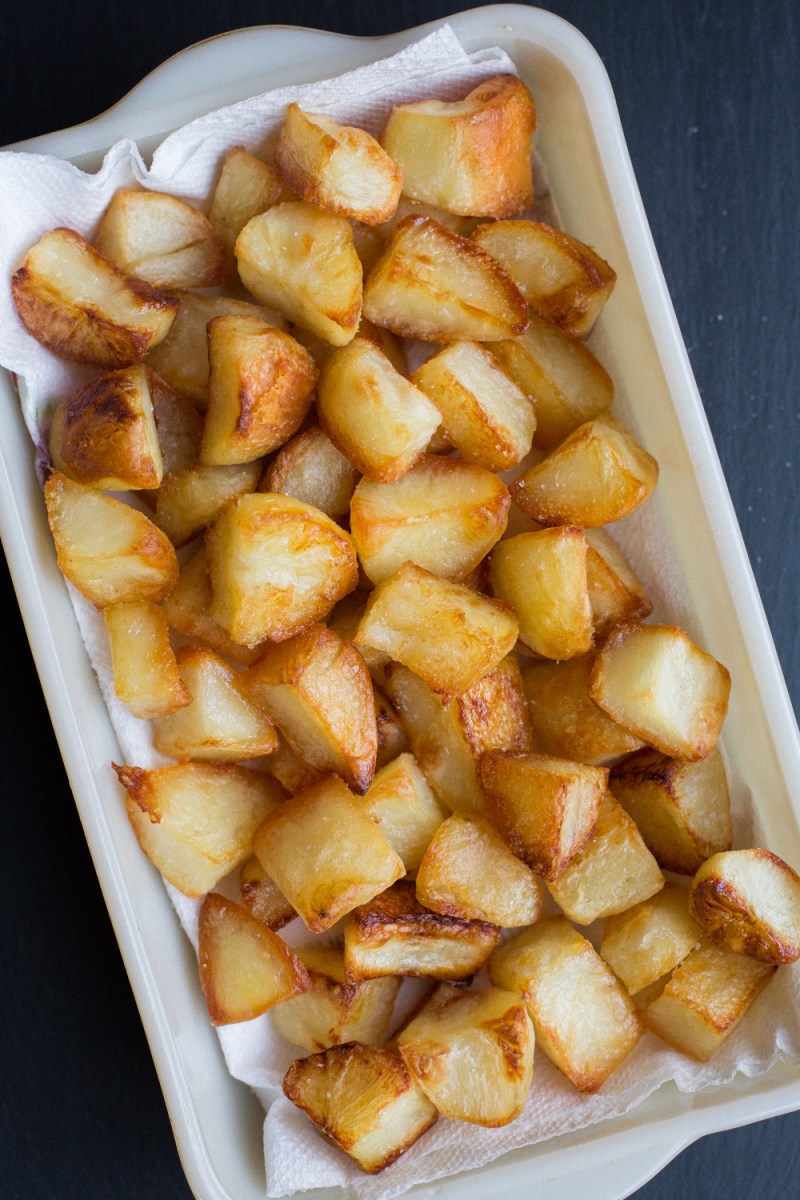
This week’s recipe is very simple, and is actually a setup for next week’s recipe. At the same time, this recipe also carries a mandate: you should be cooking with duck fat. Not only does it have an excellent nutritional profile, it is an ideal roasting fat. Potatoes in particular really shine when cooked in duck fat.

Ducks have been consumed since prehistory, but the Chinese were the first to domesticate them, over 3,000 years ago. It may surprise you but nearly all domesticated ducks, including the white Pekin duck which is the most commonly-consumed duck, are descended from Mallard ducks. The only exception is the Muscovy duck, which is a native of Central America, and has recently been gaining ground as a domesticated duck raised for food. Ducks have a thick layer of fat between their muscles and skin, to help them stay buoyant. Up until the 1900s, duck breast was more often than not served rare, something that most people nowadays (myself included) would have a hard time stomaching.

Read Full Article

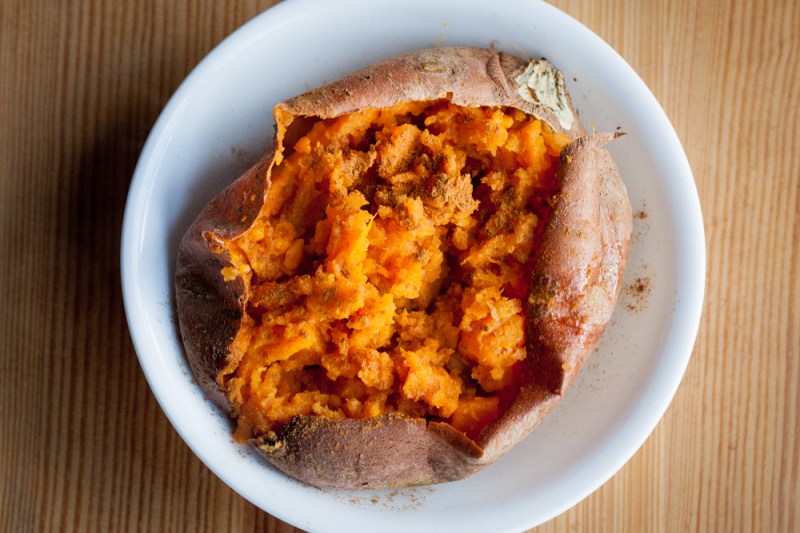
This may fall under the no-brainer category, but I thought I would explain how we bake our sweet potatoes here at the house. It’s one of our simplest recipes, and the only thing it needs is about 45 minutes of cooking time to ensure you get that perfect potato. Additionally, we like to take five seconds out of our busy day and add a little cinnamon to our potatoes, which gives just a twinge of complexity to the taste.

Here’s a couple neat facts about sweet potatoes. Sweet potatoes originated in Central/South America. Papua New Guinea eats the most sweet potatoes per capita, with 500kg per person annually. North Carolina supplies most of the sweet potatoes we find in US markets. They’re only distant cousins to the white potato, despite sharing the same name. They’re also pretty distantly related to yams (which originated in Africa), even though here in the US we often (incorrectly) label our sweet potatoes as “yams”.

Read Full Article

Mashed sweet potatoes have a distinctly different taste from your everyday mashed potatoes. Yep, you guessed it: they’re sweeter. They’re also much more delicate so they require a slightly different approach; namely, you steam them instead of boiling them.

For this recipe, I used three different sweet potatoes/yams, only because we had all three at the house. This recipe will work fine with almost any sweet tuber, although admittedly this dish looks pretty awesome with all three.

Read Full Article