

You’ve probably noticed by now that I place certain banners underneath each recipe – “gluten free, paleo-friendly, perfect health diet-friendly, contains dairy” – and I thought I should explain them a little better.
You’ve probably noticed by now that I place certain banners underneath each recipe – “gluten free, paleo-friendly, perfect health diet-friendly, contains dairy” – and I thought I should explain them a little better.

NOTE: An updated version of this recipe appears in my cookbook, The Ancestral Table.
Successfully making BBQ ribs is probably the most hotly-debated item in my repertoire. True BBQ experts insist that the only way to cook ribs is over a slow heat outdoors for a long period of time (read: all day). My recipe creates consistently-good BBQ ribs that all but narrow-minded purists can easily enjoy.

No burger should go without fries. Unfortunately, making fries at home is a mildly infuriating process, because each cooking method has serious flaws. Frying them on a stovetop can produce excellent results but uses a lot of precious oil. Reducing the oil produces uneven results and dried out potatoes. Baking them in the oven generally results in either soggy or crispy-beyond-belief potatoes. I set out to find a better oven fries recipe to save on oil costs as well as the messy, tedious work of frying potatoes in batches. I found one through Cook’s Illustrated that works well, and with a few modifications, is also Paleo-friendly.
This recipe is unique in that you cover the fries with tinfoil for the first few minutes to steam them. Also, you add salt and pepper to the pan BEFORE adding the potatoes, which actually works to keep the fries from sticking to the pan as well as evenly coating them.

Spam is very popular in Hawaii, dating back from its widespread use in World War II. In fact, spam is consumed more per capita in Hawaii than in any other state, and is even served at McDonald’s and Burger King there. This little dish also doesn’t carry the “poor people’s food” stigmatism that it enjoys in the rest of the US. Spam musubi is a variation of Japanese onigiri (rice balls wrapped in nori seaweed) and is a common snack in Hawaii; I personally lived off of them for years. We would often sneak them into our pockets for UH football games and take them on plane trips to the mainland. Ah, memories.
Now that we’ve been living in the Baltimore/DC area for the past couple years, our only shot at getting our hands on spam musubi is making it at home. Luckily my wife is awesome and can make it with her eyes closed. To capture the authentic Hawaii taste you’ll need Aloha brand shoyu (which contains soy and wheat) as well as mirin (sweet rice wine, which is hard to find without corn syrup nowadays) so I’m labeling this as an “official cheat meal”. You could definitely try it with tamari to eliminate the wheat, or coconut aminos to also eliminate the soy, but the taste may be compromised. Also, keep a look out for mirin without corn syrup, which you can find at some Japanese grocery stores.
Interestingly, spam is paleo-friendly; its ingredients consist mainly of pork products and potato starch. It is, however, loaded with sodium and nitrites, so you’ll definitely want to eat it sparingly, look for the lower sodium version, and drink lots of water! (I sound like my mother.)
Also, you’ll need a onigiri/musubi mold, which you can find on Amazon for relatively cheap.

Making a good pot roast is a infinitely rewarding experience; how else can you take a relatively cheap and tough piece of meat, leave it alone for a few hours, and have a rich and delicious meal waiting for you at the end? Sunday roasts are a tradition here in the Western world, and we don’t make this dish often enough. I have two simple rules when it comes to judging a successful pot roast: 1) it should never require a knife to cut, and 2) gravy should be minimal and complementary, and not used as a quick fix for a dry roast. Many cuts of beef can be used for pot roast, but I have found that a chuck roast has the perfect blend of affordability and marbling.
Let’s talk about how I approach this dish, and most other roasts. The term “to roast” actually means to cook in a dry heat, which can often result in a dry dish. Roasting in its most effective form is over an open flame or a rotisserie, which is definitely not what we’re going for with this dish. Most of the “roasting” I do is actually “braising” – roasting it in liquid – which is also commonly called “pot roasting” (you can see the ambiguity, right?). Braising a piece of meat is important because it allows the meat’s connective tissue to melt, resulting in a tastier and more tender dish. With a dry roast, you are likely to have a dry meat with hardened connective tissue.
I should also mention that this roast, and many of my other dishes, wouldn’t be possible without my incredible Le Creuset French Oven. What makes this oven ideal is its heavy cover which keeps moisture locked in. Its $275 price point might seem steep, but you can use it in hundreds of ways and has a 101-year warranty. If you’re going to have only one dish for the rest of your life, I say that you’d be safe with this one.

NOTE: An updated version of this recipe appears in my cookbook, The Ancestral Table.
Lomi lomi salmon is a traditional Hawaiian dish served in most luaus. It is served cold and is an interesting way to consume a good chunk of nutritious, fresh food. The words “lomi lomi” in Hawaiian actually translate to “massage”, and comes from the the mixing of the ingredients by hand at the end.
I should caveat here at that I can’t stand raw onions, so I’ve never actually had lomi lomi salmon. However, my wife loves it, and makes a killer recipe that I thought the world should know.

I spent some time in Prague last year and was introduced to česnečka (pronounced “chesnechka”), which is a simple garlic and potato soup.
I found that the soup tasted best with a mixture of my homemade beef stock, beef broth, and water. If you don’t have access to all three (my guess is you have easy access to one), improvise as needed.
NOTE: An updated version of this recipe appears in my cookbook, The Ancestral Table.
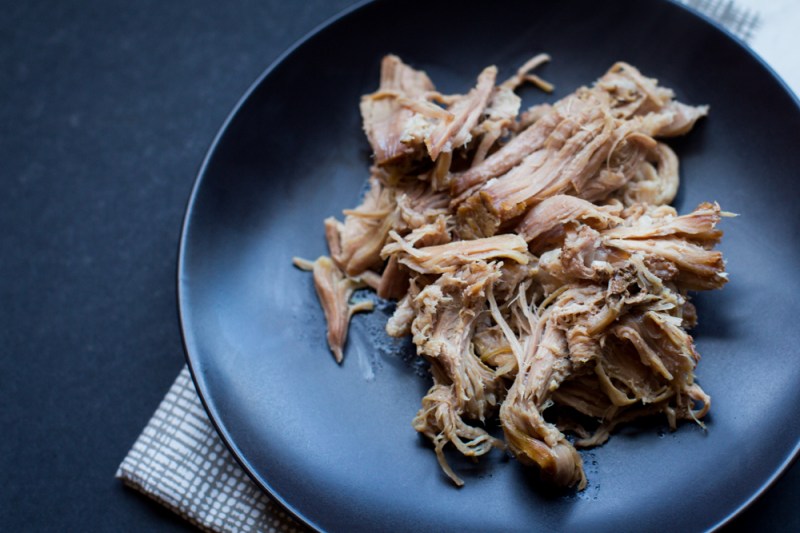
Kalua pig is one of Hawaii’s best-known dishes, and easily replicated at home. Traditionally, an entire pig is placed in an underground pit (“imu” in Hawaiian) that is lined with hot rocks and wrapped in banana leaves, then covered with a layer of soil and roasted overnight. Since we don’t have room in our back yard for an imu, nor access to a suckling pig and banana leaves, nor the desire to go through such a hassle, we just use a crock pot or french oven.
This recipe calls for about 6 lbs of pork butt, which is actually the upper half of a pig’s shoulder (the lower half is called the picnic cut, which can also be used). Pork butt is also often called a Boston butt or roast. You can also find the cut simply labeled as “pork shoulder”. Basically, any cut that’s labeled picnic, butt, shoulder or Boston should be fine.

As I was putting together a quick lunch the other day I made this simple soup, and didn’t take any pictures of the process because I assumed it wasn’t going to be a very noteworthy meal. Fortunately for me it was delicious, but unfortunately for you I don’t have any other pictures of the recipe other than the picture you see above. Regardless, I think I can still walk you through this dish without any visual help.
I lived in Hawaii for seven years, and I was lucky to learn a lot about Asian soups while I was there, and I feel that this dish accurately reflects the all-inclusive nature of Hawaiian (“local”) cuisine. This soup is a combination of many traditional dishes: I made a broth similar to Japanese shoyu ramen, but incorporated assorted Japanese fishcake from a dish called oden, and used wakame seaweed which is most commonly found in miso soup. I then used the same rice noodles used in Vietnamese pho and added fish balls, which you would find in many soups in Singapore and Malaysia.

I’m pretty sure that cheeseburgers are mankind’s greatest invention. I often imagine that if I had a time machine, the first thing I would do is travel to the Middle Ages with a perfectly-made burger and give it to a pauper and blow his mind. You think I’m joking, but I’m not. Cheeseburgers (with the bun) are probably the food I crave most, even after my palate shifted a few months ago. And truth be told, I still miss the fluffy/greasy bun associated with burgers, but I’ve come to appreciate bunless burgers as well.
I worked at a burger-centric restaurant for a couple years, and learned a couple tricks along the way. Here’s how I make a perfect cheeseburger.
 The Domestic Man