paleo

Last month I was interviewed by Jennie at Easy Paleo. Today I realized that although I mentioned the interview on my facebook page, I never put a link up on my site. So here it is! I was fun to dig in a little bit beyond the scope of just writing recipes and the occasional rant.

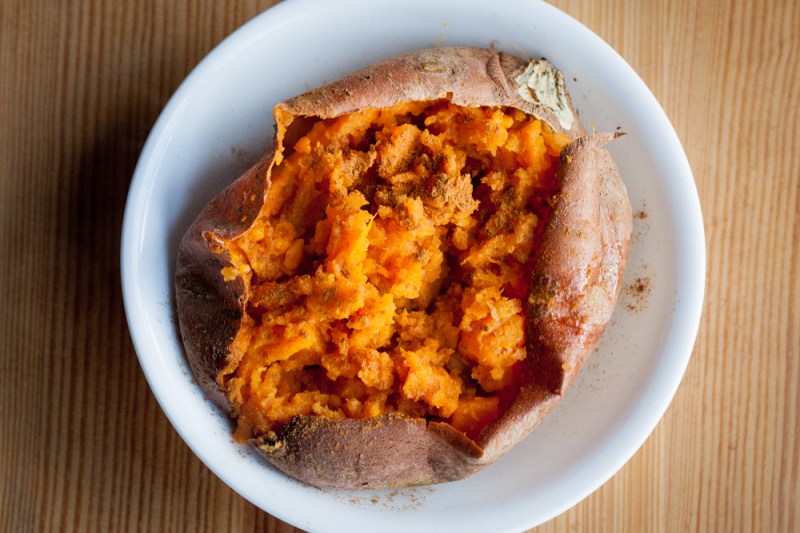
This may fall under the no-brainer category, but I thought I would explain how we bake our sweet potatoes here at the house. It’s one of our simplest recipes, and the only thing it needs is about 45 minutes of cooking time to ensure you get that perfect potato. Additionally, we like to take five seconds out of our busy day and add a little cinnamon to our potatoes, which gives just a twinge of complexity to the taste.

Here’s a couple neat facts about sweet potatoes. Sweet potatoes originated in Central/South America. Papua New Guinea eats the most sweet potatoes per capita, with 500kg per person annually. North Carolina supplies most of the sweet potatoes we find in US markets. They’re only distant cousins to the white potato, despite sharing the same name. They’re also pretty distantly related to yams (which originated in Africa), even though here in the US we often (incorrectly) label our sweet potatoes as “yams”.

Read Full Article


image courtesy of Warner Bros.

Note: this was written in January 2012. Check out my three-year recap post here.

Last month was the one-year anniversary of my switch to a modified Paleo diet (which = Paleo + white rice and some dairy). At the six-month mark I made this post with some lessons I’d learned; while many of these tips still ring true (although we haven’t had ice cream for some time now), I thought I’d add a few more.

Read Full Article

NOTE: An updated version of this recipe appears in my cookbook, The Ancestral Table.

Eye of round is a pretty intimidating piece of beef. It’s an extremely lean cut taken from the hindquarters of the cow, which gets a lot of exercise. To be honest, I usually just use the eye of round roast to make jerky (along with london broil, which is also from the same area of the cow) because making steaks and roasts with this part of the cow is usually always a gamble.

The other day I stumbled upon a recipe that seemed both crazy and intriguing; you roast the meat at a high temperature for a while, and then you turn off the oven and leave it in there for 2 1/2 hours. The end result is something like prime rib – a dark, crusty outside with a juicy, pink, tender inside. Honestly, it makes this fairly inexpensive cut of meat taste about 100x better than what you paid for. I may never cook an eye of round roast any other way for the rest of my life!

Read Full Article

NOTE: An updated version of this recipe appears in my cookbook, The Ancestral Table.

Satay is a dish that originated in Indonesia, and can be found in many Asian restaurants as an appetizer. It’s basically meat on a stick, so it has a universal appeal. Making an authentic satay dish is easy, provided you have access to the ingredients (galangal, turmeric, and lemongrass in particular).

Read Full Article

NOTE: An updated version of this recipe appears in my cookbook, The Ancestral Table.

Satay sauce is primarily a dipping sauce in the United States, but it takes on a different role in Southeast Asia, where it originated; in addition to being a dipping sauce, it is used as a general purpose condiment to provide depth to dishes, and is the pivotal ingredient in many dishes such as gado-gado in Indonesia. In Australia, it’s a flavor you can have added to kebabs (to delicious effect, I might add), and is used as a condiment in many parts of Europe as well.

Because peanuts are not Paleo-friendly, I replaced the peanuts with a combination of walnuts, almonds, and macadamia nuts. Surprisingly, you can’t really tell that there aren’t any peanuts in this sauce – it’s the combination of shrimp paste, garlic, coconut milk, and palm sugar that really give this sauce its signature taste. If you have no restrictions on peanuts, I made no other substitution so you can just throw them back into the mix.

Read Full Article

Note: an updated version of this recipe is here.

Beef stroganoff (бефстроганов) is a Russian dish that dates back to the 19th century. The dish became popular here in the US after World War II, when Russian immigrants and American soldiers returning from war brought it stateside.

Historically, the dish was served in a sauce made primarily of mustard and sour cream. Other variations include a little tomato paste for zing. Here in the US, it’s generally served with onion and mushrooms as well; it turns out that a little of everything is what tastes the best.

Read Full Article

Char siu (蜜汁叉烧, literally “fork burn/roast”) is a famous Chinese roast pork dish. Not only is it served on its own, but it is commonly found in fried rice, noodle soups, and steamed buns (char siu bao/manapua).

Today this dish is often made with maltose, which is a malt sugar made from barley. Honey is a suitable substitute, and still used by many chefs as well. Also, many restaurants will use red dye to simulate that signature red roasted look – we’re going for the real deal in this recipe.

Read Full Article

To celebrate my first year of Paleo/Gluten-Free eating, I’ve decided to do a giveaway. In the giveaway you’ll find some staples of our family’s diet – coconut oil, coconut milk, and Thai curry pastes. I’m also including a copy of the Easy Paleo: 21 Practical Ways to Simplify Your Paleo Life e-Book, graciously donated by Jennie at Easy Paleo.

In addition to getting real stuff, I’m also giving away something a little more personal: I’ll create a recipe especially for you, and post it on this site. My only stipulation is that it has to be a dish that’s traditional in nature (as in something that has existed for a while, no made-up meals like “turkey asparagus surprise”). Other than that, I have no limitations on what you choose – it can be from wherever in the world you want, as difficult as you can imagine, and tailored to whatever dietary restrictions you may have. If you don’t have any restrictions in particular, it will be made with the same guidelines I use to cook every day – meaning that it will be made with natural ingredients and without grains (except white rice) or legumes. Give me about a month to research and test your dish before I publish it.

Here’s the loot:

1. A copy of Easy Paleo: 21 Practical Ways to Simplify Your Paleo Life e-Book ($5 value)
2. One 16oz container of Whole Foods expeller pressed virgin coconut oil ($10 value)
3. Three 4oz Maesri curry pastes (green, red, and panang)* ($9 value)
4. One 14oz can of Orchids coconut milk ($2 value)
5. A personalized recipe created at your request (priceless)

* Note that the curry pastes have sugar listed in their ingredients (although it’s pretty far down in the list). If you are completely avoiding sugar altogether, let me know and I’ll send a second container of coconut oil instead.

Here’s how to enter the giveaway:

1. “Like” The Domestic Man facebook page and leave a comment letting me know you did it.
2. Follow me on Twitter and leave a comment letting me know you did it.
3. Subscribe to this site’s RSS feed and leave a comment letting me know you did it.
4. Tweet about this giveaway and leave a comment letting me know you did it.
5. Share this giveaway on Facebook and leave a comment letting me know you did it.

Your options for entering the giveaway are stackable, so you could potentially enter five times. You don’t need to leave five comments, just let me know everything you did in one comment. The giveaway ends midnight Sunday, December 18th, and I will select a winner using a random number generator sometime thereafter. Good luck!

Update: Congratulations to brunson71799 who is the big winner of The Domestic Man’s Great Giveaway of 2011! Thanks to everyone who participated.

NOTE: An updated version of this recipe appears in my cookbook, The Ancestral Table.

Chowders get their name from the French word “chaudière” (kettle, pot), which in turn is derived from the Latin “caldāria” (cauldron). There’s quite a rivalry regarding the white, creamy New England Clam Chowder and the clear, tomato-based Manhattan Clam Chowder – in fact, a bill was introduced into the Maine legislature in 1939 attempting to make it illegal to add tomatoes to clam chowder.

Here’s another interesting fact – it wasn’t until the Second Vatican Council during the 1960s that Catholics were permitted to eat meat on Fridays (the abstinence period has been reduced to Lent now). To provide a seafood option to Catholics, restaurants across the country served clam chowder on Fridays, and the tradition remains today.

Creating a hearty, traditional wheat-free chowder is quite a challenge, since they are usually thickened with flour or soup crackers. Using starchy russet potatoes would naturally thicken the chowder, but also leave you with disintegrated potatoes. And then it struck me: I can cook the chowder using sturdier red potatoes, and thicken it with potato starch – leaving us with the best of both worlds.

Read Full Article